The Wisconsin Department of Natural Resources 2020-2021 Statewide Waste Characterization Study found that wasted food and food scraps made up 20% of trash going to Wisconsin landfills. This amounts to approximately 854,000 tons annually, or 294 pounds per person, in Wisconsin during the study period. The study estimated that more than three-quarters of this food could have been consumed. A 2025 study from the EPA found that the cost of food waste to each U.S. consumer is $728 per year. When food goes in the trash, so do resources, time, and money.
In this presentation, Ruth aims to raise awareness on the scale of food waste and how it impacts the climate. Ruth will provide zero cost solutions so that consumers can manage food more effectively and prevent good food from going bad. We’ll save some money and reduce our environmental footprint.
Ruth O’Donnell has been working in the environmental protection field for over 30 years working in both the private and public sectors. She holds a Master of Science in Environmental Science and Policy with an emphasis on waste management from UW-Green Bay. Ruth most recently worked at the Wisconsin DNR as an Organic Waste Management Specialist working on a project funded by an EPA grant to reduce per-capita food waste disposed of in Wisconsin landfills by 50% by 2030, compared to 2020 levels. Recently retired, Ruth is reconnecting with her love of gardening, riding bikes with her husband and tending to her two compost bins!
Last Week: Tom Osmundson, From La Crosse to Southeast Asia
Dr. Todd Osmundson, Ph.D., is a Professor of Biology at the University of Wisconsin – La Crosse. A geneticist, mycologist (fungal biologist), and conservation biologist by training, Dr. Osmundson studied at Carleton College, the University of Montana, Montana State University, Columbia University, and conducted postdoctoral research at the University of California, Berkeley before coming to UWL in 2013. He has conducted international field research in Australia, Canada, China, Costa Rica, French Polynesia, Guatemala, Mexico, Svalbard, Thailand, and the United States, in tropical, temperate, arctic, and alpine habitats, in an attempt to better understand the global distributions, evolutionary and migrational histories, and ecology of fungi.
Lunch this week: Southwest Chicken Salad: greens, roasted corn, diced tomatoes, black beans, with cumin lime chicken, and southwest dressing.
Coffee, ice tea, and water available.
Guests are ALWAYS welcome! RSVP in advance to Niki Pohnl if know you are bringing guests but last minute invites are also welcome!
Proposed Members
The following community members has been proposed to become members of our club:
Kevin Hennessey, Representative Carpenters Union, Proposed by Brad Pfaff
Sam Scinta, CEO La Crosse Chamber of Commerce, Proposed by Rick Kyte
According to club procedure, applicant names are to be published in our weekly email bulletin for two weeks. If there are no objections from the current membership, these applications will be approved. Please contact the Club Administrator if you object to these applications by October 22nd.
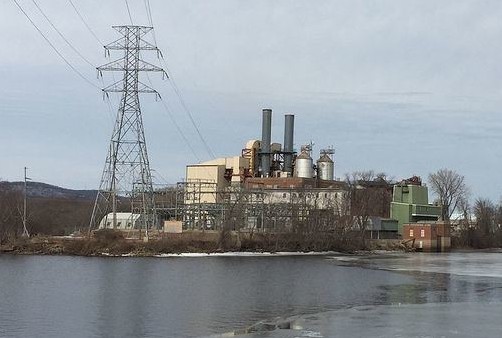
We have the opportunity to tour the French Island Refused Derived Plant as a follow up to Alex Lueck's presentation on Xcel Energy's plans for the future. The tour is November 6th at 10am.
This will be an hour long tour for members and friends.
Enter through weigh station scale. Stop and let the security guard know you are there for the tour. Proceed to the south end of the plant. Park along the right edge of the drive lane as you near the south end.
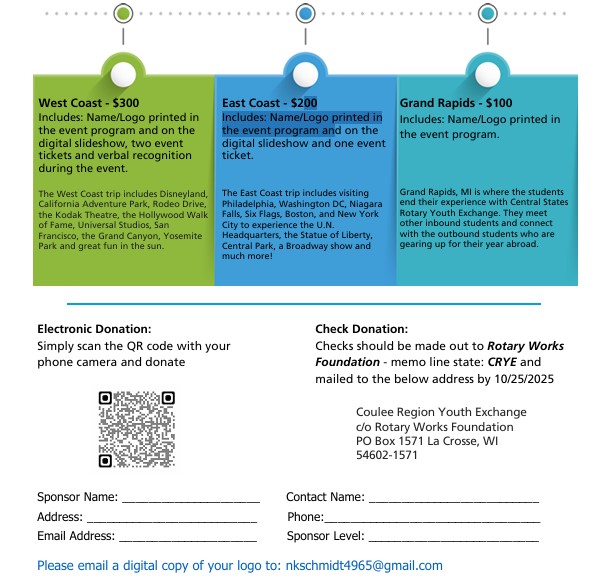
We invite you to sponsor of our sixth annual Youth Exchange Cultural Celebration planned for Thursday, November 6, 2025 from 5:30-8:00 p.m. at The Dash Center, Onalaska, WI. This is a wonderful opportunity to learn about the cultures of our Coulee Region exchange students and to show them a warm welcome.
The students have hand picked recipes that represent their culture and are working with local chefs to give attendees the opportunity to taste “comfort food” from their country. There will also be hors d'oeuvres, a cash bar, and 50/50 raffle. Proceeds from the event go towards the exchange students’ end-of-year trip to the East or West Coast of the United States. This is a once-in-a-lifetime opportunity for them.
We are grateful for any support that you can provide and we offer a variety of sponsorship levels to accommodate all levels of giving. We know that you have many choices regarding sponsorships. The Youth Exchange Cultural Celebration is valuable for our exchange students as well as our community and we hope that you will join us in sponsoring this event. The Rotary Works Foundation is a 501(c)3 organization. If you have questions, please contact Julia Behrenbeck.
Welcome to Week THREE of RI’s Month of Economic & Community Development.
The Rotary Club of Pagosa Springs has just received grants from The Rotary Foundation totaling $160,000 to support science education at the high school level in Niger and Togo. The long-term goal of these projects is to prepare students for careers that require a solid foundation in science. These projects will improve the critical-thinking skills of all students and contribute to national wealth by increasing the scientific skills of the workforce. Niger and Togo are among the poorest countries in Africa.
Nearly 50 percent of the population in Niger lives on about $2 a day. The northern area of Togo, where this project will take place, has a similar poverty rate. Economic development in these countries requires a workforce trained in medicine, engineering, agriculture and other science-based disciplines. Although biology, chemistry and physics are currently taught in the high schools, they focus on theory. Laboratory experiments as we know them are not available. Without lab experiments, students do not connect the theory with the application of science. Although these countries have a rigorous science curriculum, they have no lab manuals. They have no equipment or materials to perform experiments. The science teachers understand theory, but they have no experience with the application of science. These grants will provide lab manuals, supplies and teacher training in 15 schools in Niger and 23 schools in Togo. Approximately 140 science teachers will be trained to perform the experiments.